Written by Boston Biker on Oct 20
From Livable Streets:
—————–
We are excited to announce two opportunities – a StreetTalk featuring our Emerald Network Initiative and a limited time discount on some amazing bikes. See below to learn more!
 StreetTalk: Connecting our Urban Greenways – Building the Emerald Network
Our fall StreetTalk will explore what role the Emerald Network can play in not only increasing mobility options for people in the Metro area, but also tackling challenges like economic development, equity, climate change and public health in urban Boston. To learn more click here.
Event Details
Tuesday, November 3, 2015
5:30 – 6:30 pm Emerald Networking Reception (cash bar)
6:30 – 8:00 pm StreetTalk: Connecting our Urban Greenways
@ Boston Society of Architects
290 Congress St #200, Boston, MA 02210
Cost: $10 general admission; LivableStreets members get in for FREE
StreetTalks sell out quickly. What are you waiting for, register today!

 |
| photo credit: Kyle Ramey |
Get a Gazelle and support LivableStreets in October
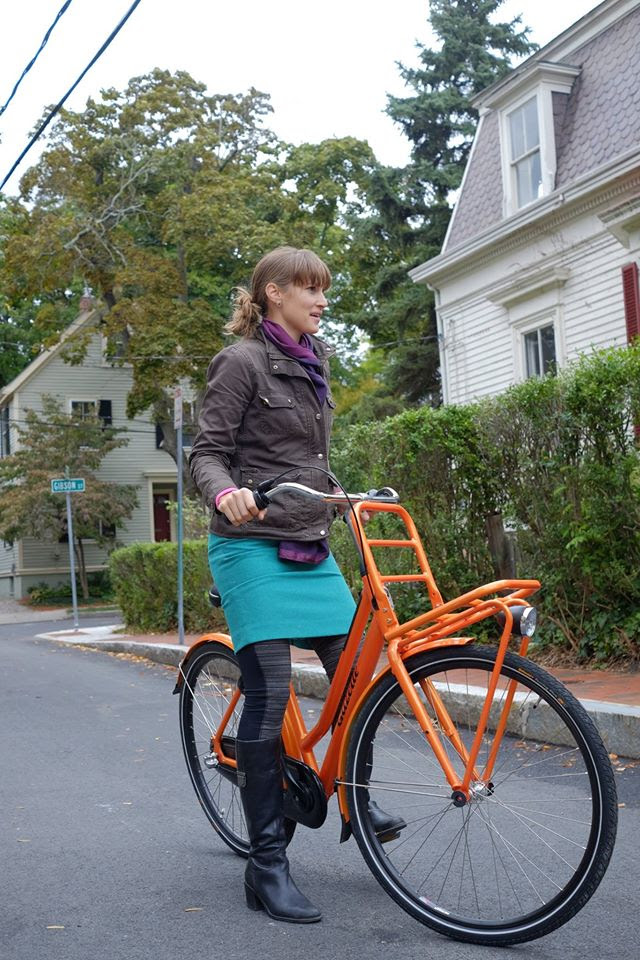
Our friends at Urban AdvenTours are selling a limited number of Royal Dutch Gazelle bikes. And in the month of October they are offering a $50 discount to anyone who mentions LivableStreets. They’ll also give LivableStreets $50 for every bike sold!
For more information or to purchase a Gazelle call Urban AdvenTours at (617) 670-0637 and be sure to mention LivableStreets!
These are sturdy, comfortable bikes made for every day riding in the city. They include built in lights, bells, a rear wheel lock …and happen to be LivableStreets orange! Swing by the LivableStreets office if you’d like to check one out before purchasing.
And don’t forget, this offer is only available during October – so get your Gazelle today!
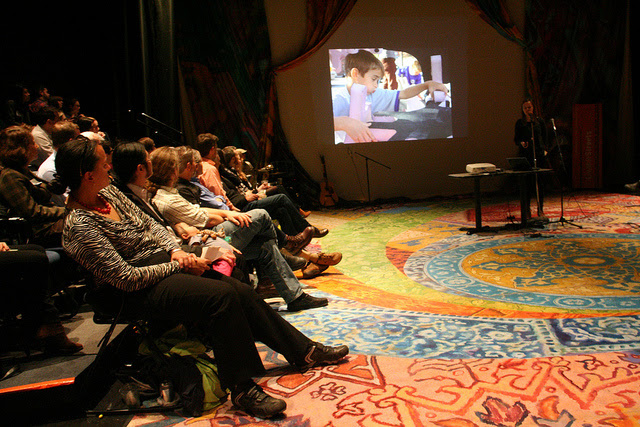 Save the date for our annual StreetTalk 10-in-1
Last, but certainly not least, we hope you’ll save the date forDecember 1, when we’ll hold our annual 10-in-1 StreetTalk.
We are planning an extra special 10-in-1 as part of our 10th Anniversary celebration and we hope you’ll join us. Look out for more details soon!
We hope to see you at our StreetTalk on November 3rd. Perhaps you’ll ride your brand new Gazelle there!
LivableStreets Alliance
http://www.livablestreets.info/

Add to Reddit.
Tags:
livable streets,
Street TalkPosted in
advocacy,
education,
fun,
infrastructure,
news |
Comments Off on Livable Streets Update
Written by Boston Biker on Jul 02
From Livable Streets, a lot of good stuff here, check it out below:
——————
You’re invited! Help Kick Off the 2013 Bike4Life Fundraiser!
Next Wednesday, come to The Lansdowne Pub in Boston at 6pm for the Bike4Life Social. Help kick off this year’s fundraising ride and reach the goal of $50,000 for more livable streets. RSVP for this free event. There will be free appetizers, cash bar and a raffle. Network, meet past riders, and learn more about the logistics of riding, volunteering, as well as the history behind Bike4Life. No commitment to riding or volunteering needed.
Bike4Life – a ride for livable streets – will take place on Sunday, September 15. There will be 20 and 40 mile routes, plus 4 and 8 mile kid rides, all leaving from Auburndale Park in Newton.
|
ArtCrank Boston
LivableStreets is excited to be the cause partner for ARTCRANK Boston. ARTCRANK BOS is an exhibit of hand-made, bike-inspired posters created by Boston-area artists. Limited edition, signed and numbered copies of all posters will be available for $40 each. Admission is free. Grab an ARTCRANK pint glass and a Widmer Brothers beer to support LivableStreets. Sounds too good to be true, right? Free event with beer, bike posters and it supports LivableStreets? It is true, and it’s happening at the Fourth Wall Project in Boston on Saturday, July 20 at 5pm. Register here for the event.

Looking to get more involved? Volunteer from 4:30-8pm or 7:30-11pm. Help sell pint glasses and posters, and talk to event attendees about LivableStreets. Email
[email protected] with the shift you are interested in helping with.
|
Rush Hour Race Recap Film
On May 11th, we answered the question, “What’s the fastest way to get from Davis Square in Somerville to Dewey Square in Boston?” Watch the four minute recap film. Tell us what you think of the film on Twitter #RushHourRace. See other StreetFilms here.
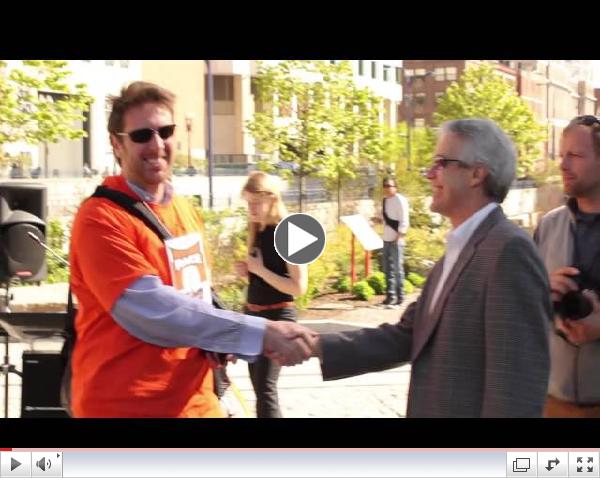 |
| Watch the 2013 Rush Hour Race recap. |
|
|
News
_______________________________________________________________________________
|
Cambridge Street Bridge Reconstruction
 |
| Cambridge Street Bridge in Allston |
MassDOT recently announced a plan to reconstruct the Cambridge Street Bridge in Allston (between Harvard Ave. and Lincoln St.), along with the pedestrian bridge that connects to it. Both of these bridges are key pedestrian/bicycle routes and it’s critical that safety is the number one priority when they are rebuilt.
The Good: Current plans for the bridge include a multi-use path connecting directly to the pedestrian bridge (which is also heavily used by people biking) and buffered bike lanes from Linden St. to Lincoln St.
The Bad: The planned bike lanes don’t extend far enough in either direction, leaving people biking without safe travel options. And, instead of providing a much-needed mid-block crossing near Linden St., MassDOT is planning to install a fence to prevent crossing at this desirable location.
How would you reconstruct the bridge?
LivableStreets and a coalition of local advocates are suggesting improvements to the Cambridge Street ridge design. Sign the coalition letter TODAY, deadline is July 3rd!
To learn more and submit your own comments to MassDOT:
|
Milliennials are Driving Less and Trend Will Continue
 The Baby Boomers started the driving boom, and their kids are currently reversing it. The Baby Boomers started the driving boom, and their kids are currently reversing it.
“The average American currently drives no more miles than at the end of President Clinton’s first term,” found MASSPIRG’s most recent transportation report.
Pat yourself on the back if you are a “Millennial,” as you are part of the group leading the change in transportation trends. “16 to 34-year-olds drove a whopping 23 percent fewer miles on average in 2009 than in 2001- the greatest decline in driving of any age group. In addition, Millennials are more likely to want to live in urban and walkable neighborhoods and are more open to non-driving forms of transportation than the older generation of Americans.”
So what happens next? This research shows a majority of people want transportation options and livable communities, but government forecasts of future travel continue to assume a steady increase in driving, as Peter Koonce discussed in our last StreetTalk. Help spread the word and get involved for more and better transportation options. Share this StreetLife newsletter and article on Facebook, Twitter and by forwarding this email to friends and family.
|
|
|
|
Volunteer Spotlight with McMillian IIderton Gaither
 Where are you from? Where are you from?
I’m from Charleston, SC.
What is your favorite street in greater Boston?
I really like the Rose Kennedy Greenway: rather than simply being a junction of major roads into downtown Boston, it is instead also pleasant and useful as a public green space for pedestrians, food trucks, markets, festivals and public art.
What kinds of projects are you involved with at LivableStreets?
I have helped out during Volunteer Fridays, at LivableStreets events, and will be helping as part of the Street Ambassador team this summer.
What does your ideal street look like?
The mall portion of Commonwealth Ave. in Back Bay is a good start: park-like, traffic is nicely divided (and calmer), and it’s prioritized for pedestrian and bike use.
What is your favorite LivableStreets advocacy project?
I like the Better Bridges Campaign for its multi-neighborhood, multi-use appeal.
>Read McMillian’s full Spotlight here.
>If you are interested in volunteering with LivableStreets, come to our
Volunteer Fridays from 12-2pm at our office, 100 Sidney Street, Cambridge. The next one happens July 12.
|
|
Jobs in the Field
Communications / Development Manager
|
Other Events and Meetings
Connect Historic Boston – Faneuil Hall Bike Ride
Wednesday, July 10, 12:30-1:30pm
@ Union Street (in front of Hubway station)
LivableStreets is proud to be on the advisory committee for Connect Historic Boston.
See ride details here>>
Longfellow Bridge Rehabilitation Project Public Meeting
Wednesday, July 10, 7-9pm
@ MIT, Building E 25, Room 11, 45 Carleton St, Cambridge
See meeting details here>>
Open Streets on the Avenue of the Arts
Sunday, July 14th, 11am-4pm
@ Huntington Avenue, Boston
Open Streets on Blue Hill Avenue
Sunday, September 29th, 11am-4pm
@ Blue Hill Avenue, Boston
Presented by Circle the City
Event details here>>
Bike4Life – a ride for livable streets
Sunday, September 15, 9am-2pm
@ Auburndale Park, Newton
20 & 40 mile rides REGISTER NOW!
www.bike4lifeboston.org
|
|
You’re invited! Help Kick Off the 2013 Bike4Life Fundraiser!
Next Wednesday, come to The Lansdowne Pub in Boston at 6pm for the Bike4Life Social. Help kick off this year’s fundraising ride and reach the goal of $50,000 for more livable streets. RSVP for this free event. There will be free appetizers, cash bar and a raffle. Network, meet past riders, and learn more about the logistics of riding, volunteering, as well as the history behind Bike4Life. No commitment to riding or volunteering needed.
Bike4Life – a ride for livable streets – will take place on Sunday, September 15. There will be 20 and 40 mile routes, plus 4 and 8 mile kid rides, all leaving from Auburndale Park in Newton.
|
ArtCrank Boston
LivableStreets is excited to be the cause partner for ARTCRANK Boston. ARTCRANK BOS is an exhibit of hand-made, bike-inspired posters created by Boston-area artists. Limited edition, signed and numbered copies of all posters will be available for $40 each. Admission is free. Grab an ARTCRANK pint glass and a Widmer Brothers beer to support LivableStreets. Sounds too good to be true, right? Free event with beer, bike posters and it supports LivableStreets? It is true, and it’s happening at the Fourth Wall Project in Boston on Saturday, July 20 at 5pm. Register here for the event.
![]()
Looking to get more involved? Volunteer from 4:30-8pm or 7:30-11pm. Help sell pint glasses and posters, and talk to event attendees about LivableStreets. Email
[email protected] with the shift you are interested in helping with.
|
Rush Hour Race Recap Film
On May 11th, we answered the question, “What’s the fastest way to get from Davis Square in Somerville to Dewey Square in Boston?” Watch the four minute recap film. Tell us what you think of the film on Twitter #RushHourRace. See other StreetFilms here.
![Rush Hour Race 2013]() |
| Watch the 2013 Rush Hour Race recap. |
|
|
News
_______________________________________________________________________________
|
Cambridge Street Bridge Reconstruction
![]() |
| Cambridge Street Bridge in Allston |
MassDOT recently announced a plan to reconstruct the Cambridge Street Bridge in Allston (between Harvard Ave. and Lincoln St.), along with the pedestrian bridge that connects to it. Both of these bridges are key pedestrian/bicycle routes and it’s critical that safety is the number one priority when they are rebuilt.
The Good: Current plans for the bridge include a multi-use path connecting directly to the pedestrian bridge (which is also heavily used by people biking) and buffered bike lanes from Linden St. to Lincoln St.
The Bad: The planned bike lanes don’t extend far enough in either direction, leaving people biking without safe travel options. And, instead of providing a much-needed mid-block crossing near Linden St., MassDOT is planning to install a fence to prevent crossing at this desirable location.
How would you reconstruct the bridge?
LivableStreets and a coalition of local advocates are suggesting improvements to the Cambridge Street ridge design. Sign the coalition letter TODAY, deadline is July 3rd!
To learn more and submit your own comments to MassDOT:
|
Milliennials are Driving Less and Trend Will Continue
![]() The Baby Boomers started the driving boom, and their kids are currently reversing it. The Baby Boomers started the driving boom, and their kids are currently reversing it.
“The average American currently drives no more miles than at the end of President Clinton’s first term,” found MASSPIRG’s most recent transportation report.
Pat yourself on the back if you are a “Millennial,” as you are part of the group leading the change in transportation trends. “16 to 34-year-olds drove a whopping 23 percent fewer miles on average in 2009 than in 2001- the greatest decline in driving of any age group. In addition, Millennials are more likely to want to live in urban and walkable neighborhoods and are more open to non-driving forms of transportation than the older generation of Americans.”
So what happens next? This research shows a majority of people want transportation options and livable communities, but government forecasts of future travel continue to assume a steady increase in driving, as Peter Koonce discussed in our last StreetTalk. Help spread the word and get involved for more and better transportation options. Share this StreetLife newsletter and article on Facebook, Twitter and by forwarding this email to friends and family.
|
|
|
|
Volunteer Spotlight with McMillian IIderton Gaither
![]() Where are you from? Where are you from?
I’m from Charleston, SC.
What is your favorite street in greater Boston?
I really like the Rose Kennedy Greenway: rather than simply being a junction of major roads into downtown Boston, it is instead also pleasant and useful as a public green space for pedestrians, food trucks, markets, festivals and public art.
What kinds of projects are you involved with at LivableStreets?
I have helped out during Volunteer Fridays, at LivableStreets events, and will be helping as part of the Street Ambassador team this summer.
What does your ideal street look like?
The mall portion of Commonwealth Ave. in Back Bay is a good start: park-like, traffic is nicely divided (and calmer), and it’s prioritized for pedestrian and bike use.
What is your favorite LivableStreets advocacy project?
I like the Better Bridges Campaign for its multi-neighborhood, multi-use appeal.
>Read McMillian’s full Spotlight here.
>If you are interested in volunteering with LivableStreets, come to our
Volunteer Fridays from 12-2pm at our office, 100 Sidney Street, Cambridge. The next one happens July 12.
|
|
Jobs in the Field
Communications / Development Manager
|
Other Events and Meetings
Connect Historic Boston – Faneuil Hall Bike Ride
Wednesday, July 10, 12:30-1:30pm
@ Union Street (in front of Hubway station)
LivableStreets is proud to be on the advisory committee for Connect Historic Boston.
See ride details here>>
Longfellow Bridge Rehabilitation Project Public Meeting
Wednesday, July 10, 7-9pm
@ MIT, Building E 25, Room 11, 45 Carleton St, Cambridge
See meeting details here>>
Open Streets on the Avenue of the Arts
Sunday, July 14th, 11am-4pm
@ Huntington Avenue, Boston
Open Streets on Blue Hill Avenue
Sunday, September 29th, 11am-4pm
@ Blue Hill Avenue, Boston
Presented by Circle the City
Event details here>>
Bike4Life – a ride for livable streets
Sunday, September 15, 9am-2pm
@ Auburndale Park, Newton
20 & 40 mile rides REGISTER NOW!
www.bike4lifeboston.org
|
|
Add to Reddit.
Tags:
livable streets,
Street TalkPosted in
advocacy,
fun |
Comments Off on Street Life
Written by Boston Biker on Nov 30
From the email, this looks interesting.
————–
Tuesday, December 11, 6:00-9:00pm. Networking & socializing to follow presentations.
@ 70 Pacific St, Cambridge (around the corner from our office)
Open to the public. $5-$15 suggested donation. Beverages provided by Harpoon.
RSVP here

Come hear exciting presentations about:
- Huntington Ave exclusive transit lane plan
- The Hubway Data Visualization Challenge
- A Coleman Street Playway in Boston
- and much more!
Come hear 10, seven minute, innovative transportation research and advocacy stories given by students, advocates, consultants, city planners and engineers from around the Boston area. Want to present? You still have two days to submit your idea.
Add to Reddit.
Tags:
livable streets,
Street TalkPosted in
advocacy,
fun |
1 Comment »
Written by Boston Biker on Jun 22
Got this in the email from Livable Streets, always a good time at these things.
| Join us next Wednesday at Brickbottom Lofts for our StreetTalk: How overpasses are so 1950’s. Find out how overpasses have been removed across the country and in our own backyard, and how you can help Remove McGrath.
|
|
StreetTalk: How overpasses are so 1950’s
co-sponsored by On the Move Coalition
Wednesday, June 27th 7:00-9:00pm
@ Brickbottom Artists Building, 1 Fitchburg Street, Somerville, MA
Open to the public-suggested $5-$10 donation
Beverages provided by Harpoon Brewery
[email protected]
Overpasses are becoming a thing of the past. The Casey Overpass in Jamaica Plain, Sullivan Square Overpass in Charlestown, and overpasses across the country are coming down and city streets are being redesigned. Will the McCarthy Overpass in Somerville become the next overpass to come down? Or will MassDOT spend $11
 |
|
Will MassDOT keep this 1950’s structure or design the road for the future?
|
million to repair the structure which acts a barrier for you to get where you want to go? Come to Brickbottom to get the latest news on the McCarthy Overpass project, the Remove McGrath Campaign, and hear how other cities are removing their overpasses. How has the McCarthy Overpass affected the Environmental Justice communities along the McGrath corridor? What is the timeline of this project?
Be part of the discussion, and then take action
-Call and/or email your state reps
-Sign a postcard to MassDOT Secretary Davey and Somerville Mayor Curtatone
-Get involved with the campaign and become and an Ambassador
*Spanish translation will be available* traducción en español disponible
Hope to see you on the 27th,
Kara Oberg
Program Coordinator
PS-Help spread the word, stay involved, whether you can make it to the event or not,Follow #RemoveMcGrath/ Check out www.livablestreets.info/project/remove-mcgrath/
Invite friends on Facebook here>>
On the Move (OTM) is a coalition of community based organizations in greater Boston that came together in 2000 to advocate for transportation justice.www.bostononthemove.org
LivableStreets Alliance is your advocate for a better balance of walking, biking and transit with the automobile.
www.livablestreets.info
|
Add to Reddit.
Tags:
Livable Streets Alliance,
Street TalkPosted in
advocacy |
Comments Off on Street Talk: How Overpasses Are So 1950’s
Written by Boston Biker on May 12
Thursday, May 17, 6:30 pm
@ Boston Society of Architects, 290 Congress Street, Boston

Learn how people are breaking the rules of traffic planning and engineering to forge a new frontier for livable cities. Hear about the paradigm shift that is happening around the world, innovative examples, and how the Boston region is reacting and paving the way.
LivableStreets is teaming up with the Boston Society of Architects Urban Design Committee for this event to discuss the future of street design, what is possible, and how you can create change.
Speakers:
Jackie Douglas, Executive Director, LivableStreets
Jeff Rosenblum PE, Co-founder,LivableStreets /Transportation Planner,City of Cambridge
Open to the public. Beverages and snacks will be served.
RSVP to [email protected] with “May 17 StreetTalk” in subject
Invite friends on Facebook here >>>
Add to Reddit.
Tags:
livable streets,
Street TalkPosted in
advocacy,
fun,
infrastructure |
Comments Off on StreetTalk: Outlaws of Street Design

 Here is what people are saying