How To Avoid The New MBTA Fare Hikes
Written by Boston Biker on Apr 05Prices are going (for charlie card users) from $1.70 to $2.00 per subway ride, or a .30 increase. Assuming you don’t use a monthly pass, and you ride the T on average 2 times a day, you are looking at an extra (.30 X 2 X 7) $4.20 a week, or ($4.20 X 4) $16.80 a month, or ($16.80 X 12) $201.6 a year. Again assuming 2 trips a day, you used to pay $1241, now you are going to pay $1460.
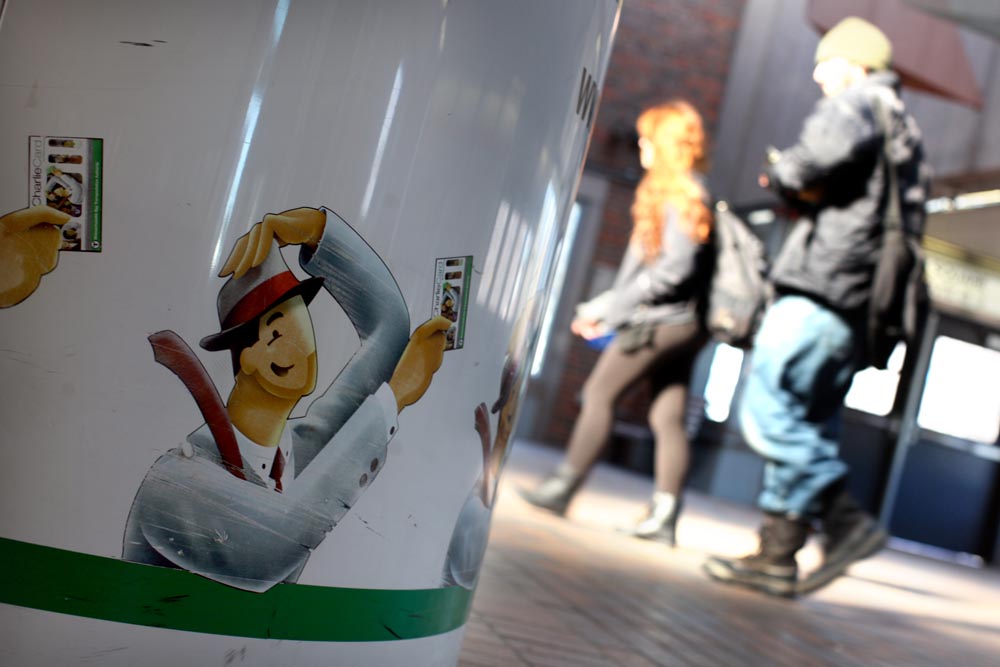
The changes are going to cost you $201.60 extra a year…or will they.
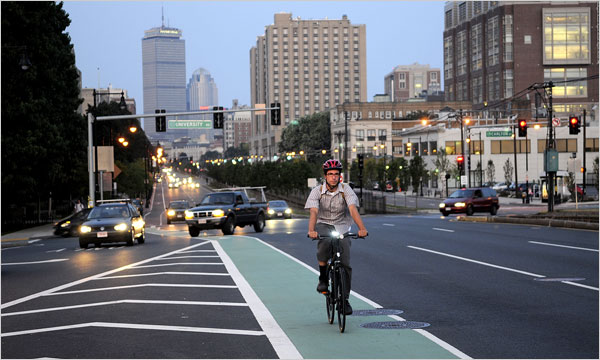
Check this out.
If you own a bicycle (that thing in the basement that you have been ignoring for the last decade), you can save $4 a day by simply using it to get to work instead. To offset $201.60 you only need to ride your bike roughly 51 times.
If you only ride when its nice, say in the spring and fall, when its not too hot or too cold, and it isn’t raining you should easily accomplish this price reduction. Plus the added health bonus might even save you more money at the doctors.
Now let say you don’t own a bicycle, lucky for you Boston just installed the new Hubway system. Right now they are offering $50 yearly memberships, so you would only need to take Hubway to work ($201.60 + $50.00 = $251.60) roughly 63 days to completely eliminate the MBTA fare hike. Again assuming you do this during the nice parts of the year, or only on nice days, you should easily accomplish such a task.
The more you ride, the more you save!
Tags: fun with math, MBTA
Posted in advocacy, Commuting, fun | 9 Comments »


By William Furr
on Apr 5, 2012 | Reply
I rode the train all last week and was shocked how much it cost me.
Shame it’s so much easier to convert transit riders into cyclists rather than car drivers.
By Erik
on Apr 5, 2012 | Reply
Not to mention that you save heaps of time, even riding at a leisurely pace, if you have to go “crosstown” (e.g., Allston/Brookline –> Camberville).
By Sarah
on Apr 5, 2012 | Reply
You realize that if you are taking the T twice daily then you would save a ton of money immediately by just getting a monthly pass, right?
By h4ckw0r+h
on Apr 5, 2012 | Reply
I don’t follow your math, Sarah. If I buy a monthly linkpass for $70 (the new cost), I’m out $70 immediately and don’t see any cost decrease until the end of the month. So there’s no immediate cost savings at all. The cost savings are only realized at the end of the month.
The new cost for a monthly linkpass is $70. That’s only $10 less than the cost of commuting on the T twice each business day in a month — not a ton of money.
If you commute on the T twice each weekend day (not what this article is talking about), you’ll spend $70 instead of $120.
If your T pass is subsidized by section 132 benefits at work, you’ll pay with pre-tax dollars; assuming a 30% tax rate you’re still out $49/month.
If you bike from May through October, only on days that aren’t raining (~80% of all days — check world weather information to get the mean number of precipitation days each month), that’s ~96 days of cycling where you pay effectively $0 and ~24 days where you pay $4/day ($96). If you were buying a Linkpass at $49/month for six months instead, that would cost you $294. So even paying out-of-pocket on those rainy days you’re spending less by cycling instead of taking public transportation.
Even if you’re cycling on the weekends, 153 days, 20% of which are rainy, rounding up is 31 days you’re using the T — or $124 expense by cycling instead of $294 expense for a $49 Linkpass. Still a bundle of money saved!
By MathGuy
on Apr 5, 2012 | Reply
What about the transfers? Your math is all wrong buddy.
Every 2 rides cost 1.70 + .45. That’s $2.15 per day, assuming you’re only riding the subway 2 times per day as the article suggests. For a year that would end up $784.75 (2.15*365)
With a pass, you’ll only pay $708.
The new price, assuming the transfer rate increases just as much (after all, I believe it’s structure so you can take a bus and a train in one go with only the normal cost of a train ride) will be $894.25
That’s a $109.50 increase, not $201.60, per year.
The math about savings and how many rides you can go for on your bike are strangely nearly the same number even though the fare is different. (51 and 63 rides respectively…weird huh?)
The new cost for a year’s worth of link passes (according to hackworth) will be $840.
I’m sure a bike will still help you save
About passes, 2 things.
1: “Assuming you don’t use a monthly pass[...]”
Why would you EVER assume this? I know not everyone knows about monthly passes, but if you do and you hate wasting money, this is bad choice to make!
Not to mention, you’re getting nearly unlimited rides on the subway AND the bus. Even if you only need to travel on average 2x a day, just knowing you can travel more often and still spend less should make you feel good.
2) on hackworth’s portion to Sara:
I don’t know what kind of math you’re using if you want to begin to tell me that using a pass does not save you money, especially as someone who spends about 50% less per month in fares because of that piece of plastic.
Also, a little more math correction. Again, assuming one rides the subway 2x a day – only this time we’re limited to business days as in hackworth’s scenario. That’s 2.15*20 average business days in a month, which is $43…and is significantly less than $70 by almost 100%
I don’t know anyone who buys a monthly pass and expects to see immediate savings upfront. With that kind of logic just what IS your approach to purchasing a home, a car, or acquiring a loan, etc?
You don’t need to see actual money saved to know that you’re money is being spent efficiently as possible.
Also, in general…I travel 25 miles back and forth every day….I know I probably wasn’t in mind, along with my traveling companions…but it’s just a note to change from a less sensational title to one that’s more closer to truth, even if it won’t garner you as many views.
By Erik
on Apr 5, 2012 | Reply
Mathguy–you’ve got your transfer math messed up. Basically you get a free transfer, which can be bus bus or bus subway (subway subway is not an option). When you use your free transfer, you only pay the price of the most expensive mode. So if you transfer bus –> bus, your trip costs a TOTAL of $1.25. If you transfer bus subway, your trip costs a TOTAL of $1.70 (i.e., $1.25 + $0.45 = $1.70). But you generally can’t do a round trip using a transfer, so the point is mute.
Basically, you’re looking at a $0.60 increase per roundtrip if you use the subway, or $10 increase per month if you’re using a monthly pass. It should be pretty simple.
Also, $43 is less than $70 by about 40%, not “almost 100%.”
By Erik
on Apr 5, 2012 | Reply
Lol “point is mute.” Moot too.
By Jo
on Apr 5, 2012 | Reply
It is telling that all of our fare math is wrong. Cyclists don’t know the intricacies of the T and that’s not a bad thing.
By h4ckw0r+h
on Apr 5, 2012 | Reply
Er, Mathguy, I didn’t say that buying a Linkpass didn’t save you money over paying for each ride individually. I illustrated that a Linkpass costs more than cycling when the weather is nice (where “nice” is defined as not raining and from May through October) and paying for the remaining rides individually. That’s the premise of this article. Granted you’d want a Charlie Card instead of paying in cash in order to take advantage of the transfer system, if both forms of mass transit apply.
I also didn’t say that you would see immediate savings up front. I said that the cost savings would be realized after the end of the month. To be precise, the break-even point is after 87.5% of the monthly T rides and the remaining rides are gravy. So you’re better off without a Linkpass if you’re not going to the office for three or more days that month.
If you can demonstrate that buying a Linkpass and using only mass transit is the cheaper choice over not using a Linkpass and cycling to work on the nice days, please do so.