The Latest From BostonBiker.org
News, Events, Updates
Targeted Enforcement, And Why It’s Time To Have More Of It For Pedestrians
Written by Boston Biker on Apr 30For the last couple of days I have been seeing cyclists in packs standing in front of a Cambridge cop getting a lecture about why they shouldn’t run red lights, some even being issued warnings/tickets.
They usually hide out at the same spots (near the Longfellow bridge, at the corner of prospect and mass ave, various other places), and if you are clever (or just paying attention), you can always see them waiting to catch people who break the law.
A lot of people hate this, but I LOVE it. I have written ad nauseum about the problem with the road culture here, Boston road users do things that people in other areas simply don’t, including running red lights, running stop signs, j-walking, speeding, not using signals, and in general being huge jerks. The only thing that people seem to value is their time, so forcing them to pull over and get a lecture, a warning, or a ticket wastes their time, and I think generally makes them less likely to do the bad behavior again.
I have seen plenty of (almost exclusively) Cambridge cops pulling over cars, and cyclists and giving them tickets/warnings. But there is one user group that always escapes the targeted enforcement, pedestrians.
It’s time for this to change. Pedestrians need targeted enforcement, the same way cyclists and motorists do. If you don’t believe me simply go to any street corner and watch them break just about every law that is breakable. Downtown Boston, near any T-stop, and a million other spots you would talk yourself hoarse giving warnings to J-walkers. They are a danger to themselves, and others, but they hate being bothered, and maybe just maybe they would knock if off given enough warnings.
I love targeted enforcement, I love it when I see red light runners getting warnings, and tickets being issued, its long overdue to include pedestrians in the group of road users being targeted for enforcement. In theory this should already be happening (see here), but in practice pedestrians are never targeted, we will never change the road culture of Boston until we educate all user groups equally.
 Add to Reddit.
 Posted in advocacy | 5 Comments »
You Wait On The Side Walk And Wait For The Little Man Signal
Written by Boston Biker on Aug 04I never thought I would see the day when car drivers are now no longer the main source of frustration in my daily commute…Pedestrians we need to talk.
I feel like there has been a lot of effort to get cyclists and motorists to act less like assholes, and to my untrained eye it seems like it is working. I see far less rule breaking from these two road using classes than I did 5 years ago. The change has been slow, and we certainly have a LONG way to go, but its working.
There is one user group however that hasn’t kept up with the “new normal” of road use here in Boston, yes I am talking about you pedestrians. If anything the more orderly traffic patterns, and more well behaved motorists and cyclists seem to have emboldened you to act even worse.
In the same way that cops will pick an intersection and hand out bike tickets, and motorist tickets its time for some targeted enforcement of pedestrians. Even written warnings will do. The time it takes the cop to write out the warning is enough of a punishment to get most peoples attention.
Until that starts to happen, here are some tips for pedestrians, please stop doing the following.
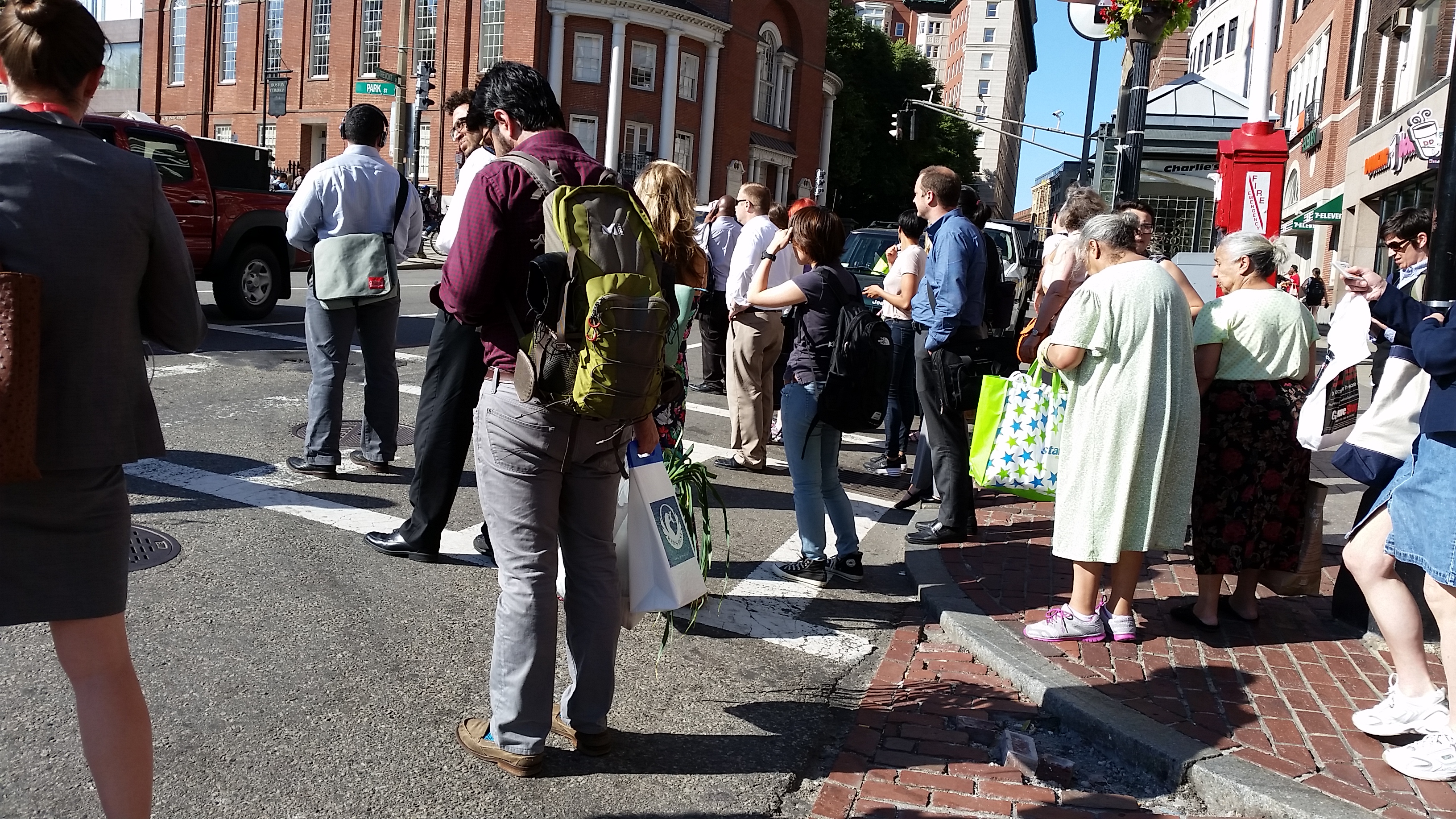
These people are in traffic, you can see the cars going by in the background, they just kept inching out. The light didn’t change for another 5 minutes.
Wait on the sidewalk for the light to change, do not stand in the street:
Cyclists need every inch of road we can wrestle from cars and if you are standing in the road it forces us into conflicts with much bigger more dangerous things. If its a choice between hitting you and getting hit by a car the choice is clear.
Don’t walk from between parked cars:
I feel like this is street crossing 101, but for fucks sake do you want to be hit by something? What is worse is that you are putting other people in danger with your foolishness. You will eventually be hit by something doing this, its just a matter of time. Please don’t be a jerk, don’t hurt yourself or others, walk the extra ten feet to the cross walk and cross with everyone else.
Just because the car traffic is stationary that doesn’t mean the cyclist traffic is:
Cyclists move down the bike lane, or down the right hand side of the road, just because the cars are stopped doesn’t mean the cyclists are. Playing frogger through a bunch of car traffic that isn’t moving is the same thing as jumping out from behind a parked car. You will be hit, it will hurt, you will break something. Oh by the way, just because the cars are not moving now doesn’t mean they wont start moving in a second.
If you must J walk, look both ways first!
Knowledge is knowing the street is one way, wisdom is looking both ways anyway. You might think nothing is coming, you might not hear anything, but you can’t be sure unless you look both ways. Cyclists don’t make much noise, but it will still hurt if they hit you.
You have to wait your turn:
If you want motorists and cyclists to stop at red lights, and stop signs you can’t just go when the red hand is up. Whats worse is when you look both ways, see a bunch of traffic coming, and walk out anyway. Its exactly the kind of behavior that would frustrate you if you were in a car or riding a bike, but you seem to have no problem doing it when you are walking around. You are needlessly putting yourself and others in danger, and being a jerk at the same time.
I don’t think these are unreasonable demands. Nor are they burdensome to the pedestrians that want to use the street. I understand signal timing can be wrong, or that walk times are too short, but none of that has anything to do with what I have mentioned above.
In short, stop being such an asshole and start being more invested in your own safety and the safety of those around you.
Add to Reddit. Posted in Bike Business | 12 Comments »
How To J-Walk, A Guide For Idiots
Written by Boston Biker on Oct 18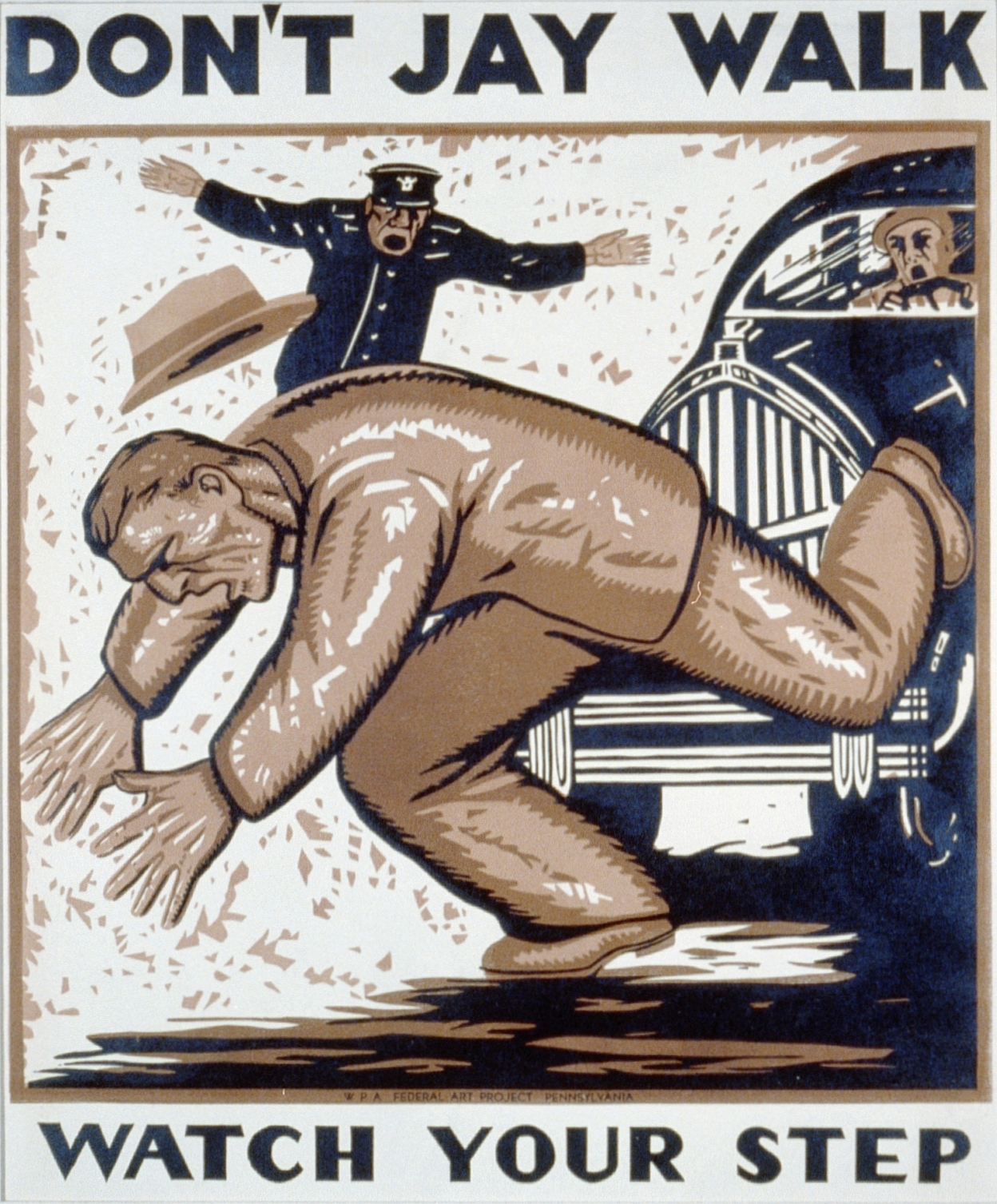
Pedestrians, lean in, its time we had a chat. I have said many times that no one user group is any worse at using (or abusing) the rules of the road, there is one difference. There seems to be a lack of education/enforcement when it comes to dealing with pedestrian scofflaws. Both motorists and cyclists have been the recipient of a whole raft of education and enforcement measures lately (and they even seem to be having positive effects), but pedestrians have been left out.
Not anymore!
Now I don’t have anything in particular against J-walking, but there is a right way to do it, and a wrong way. This is called the idiots guide, because if you are doing it the wrong way, you’re an idiot.
Before I get to the steps, let me just take a moment to try and help you re-frame the way you think about traffic. Right now you probably think about traffic as something “IN YOUR WAY!!” I think this is why people are so angry all the time.
Try to imagine instead. The streets are a public utility designed to move people. These people have many different ways of moving, some in cars, some on bikes, some in buses some on foot, etc. These people move best when they work together, following some simple rules designed to keep them all moving. Traffic isn’t something in your way, traffic is a dance. An intricate and lovely series of steps.
When performed well, no one has their toes stepped on. If you do the wrong dance steps, you fuck it up for everyone else. With the added bonus that people can get seriously hurt. So the next time you start doing the electric slide, while everyone else is doing a waltz think for a moment, you could be about to seriously injure or kill someone else because you can’t remember what tune is playing.
How to J-Walk, a guide for you idiots:
Step 1.
DON’T! Seriously how fucking hard is it to wait another 20 seconds for the little walk man to come on, or to walk 5 more feet to the crosswalk, or to wait on the FUCKING SIDEWALK instead of waiting in the damn street? Huh? I see people all the time who are clearly big wig top of the company CEO types who can’t figure out how to cross the damn road!
Step 2.
Assuming you must j-walk, follow these simple rules to get across the street without killing yourself or others.
Look both ways:
Its been said a million times, but it really is the foundation of safe j-walking, LOOK BOTH WAYS! Not once, not twice, but the ENTIRE FUCKING TIME you are crossing the street. You are cutting in, adding another dance partner to the mix, its your job to watch out for stuff You can’t just assume that what you saw when you started crossing the street will be like that when you get half way across. This is a dynamic system, and if you want to subvert it by crossing in the middle of the road, you need to be on your A game and keep your head up and your eyes open looking around you the entire time. Traffic will change, and you might have to adapt to new situations.
Get off your phone:
This city is too damn crowded for you to be looking at your text’s while walking out into multi-lane traffic. Seriously don’t be the dumb ass who gets run over by a bus because you were reading a Facebook update about what someone had for breakfast. Life is just too short for that sort of foolishness.
Take a moment to learn the traffic patterns:
Sure, those cars look like they are stopped, but did you notice that the light just turned green. The cars and cyclists certainly did. Maybe now is not the best time to walk into the damn road? Traffic is not a stationary solid state object, it is a dynamic ever changing thing. If you can’t predict what traffic is going to do in the next 30-60 seconds, you are basically gambling with your life. Is it worth it? Whats worse, is you might be gambling with someone else’s life as well. Could be mine, I might dodge you and end up under the wheels of a bus, or I might crash into you and we could both die. Learn how traffic works, learn to predict it well, you have decided to J-walk, this skill might literally save your life.
Look Left:
Just because traffic is moving one way doesn’t mean that someone might be going the wrong way down the street. Don’t just assume that because all the traffic is moving right that you don’t have to look left. This is your body we are talking about, take a moment to do some common sense checks before thrusting it boldly into a bunch of moving vehicles. Also pro-tip, this will also help younoyice people turning onto your street, pulling out of drive ways, and other totally legal shit that you didn’t even think about before you stepped into the damn road.
Don’t Follow The Herd:
If billy jumped of a bridge would you? If billy got himself two broken ribs and a punctured lung because he walked out in front of a cyclists going full tilt down the street (even though the cyclist had a green light and you were not supposed to cross then)? Just because someone else is walking doesn’t mean you should. Make sure you evaluate the situation your damn self before j-walking. Do you trust those other morons with your life?
Don’t do any of the following:
- Don’t cross from between parked cars. Duh moron no one will see you until they run into you.
- Don’t thread through stopped traffic. Stupid that traffic is only stopped for a moment, what are you going to do when it starts again and you are in the middle of the road with no where to go?
- Don’t walk out in front of cyclists. They move just as fast as the traffic, and having a wheel embedded into your sternum will hurt just as much if not more than bouncing off a plastic quarter panel. Plus you are going to hurt the cyclists. Not cool bro.
- Don’t wait to cross IN the street. As a cyclists I sometimes am forced to use the entire road to get away from crazy drivers. If you are in the road waiting to cross, you have cut off one of my escape routes, a route that might save my life. Don’t do this.
- Don’t Run/Jog in the road. Especially during rush hour. I don’t ride on your sidewalk, you don’t jog (with your headphones on no less), in the street. Your cardiac fitness is not worth it. Also you make me have to move way over to avoid you, see above. Dumb.
- Don’t use your children as armor. Nothing is more scary than seeing someone blindly walk into the street with kids. You panic every other road user, causing a righteous cluster-fuck. Your little spawn might make it through alive, but what about everyone else? Think with your brain stupid, you’re supposed to be teaching them good behaviors.
Following these simple steps should allow you to cross that street at high speed, save yourself 20 steps to the corner, get to that T-stop faster than anyone else, all without causing a huge fucking disaster for every other road user. Good luck, and HEADS UP!
Did I miss anything, leave tips for pedestrian J-walkers in the comments below.
Add to Reddit. Posted in education | 6 Comments »
A New Standard Of Employment: The Street Crossing Test
Written by Boston Biker on Aug 28I have written a lot in the past about my belief that no single user class in Boston is any more or less guilty for the state of our streets than any other. I think cyclists, pedestrians, and motorists are all equally to blame for poor performance of our streets (AKA: public utilities designed to move people).
So don’t take this post as an indication that I am singling out only one user group for scorn, as I have heaped it upon them all in the past, and will so again in the future.
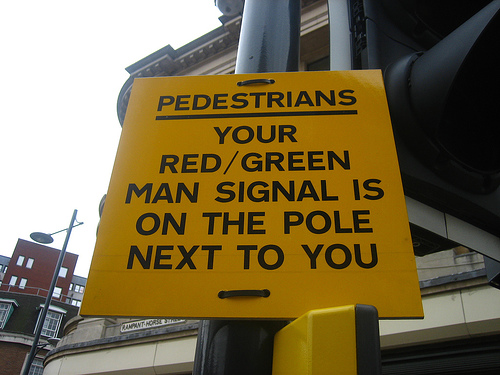
It’s just that I have had a lot of trouble with pedestrians lately, and it gave me an idea. A new criteria for hiring employees should be a test to see if they know how to cross the damn road.
First a couple examples:
Lady wants to cross the street, lady looks both ways, lady sees not one, but many cyclists in the bike lane about 10 feet from her. Everyone screams at her, she does walks out anyway.
Cyclists scatter in all directions. I should also note, this wasn’t at a cross walk, or anywhere near a cross walk.
Guy wants to cross the street, cars are moving in the lanes, he is not at a cross walk. He steps into street anyway. All of the cars slow/swerve to miss him. At no point was he in any real danger of being hit by anything, until he decided to jump from where he was, to where I was going around him. He is flexing his muscles like some sort of bro-dude frat-boy show of manly strength and begins to scream at me. I have no idea why he did this, perhaps he was worried I didn’t see him (I saw him get out of bed I had been watching him so long). I was able to swerve out of the way of this hulking idiot (thus preventing the implanting of my front wheel into his sternum), safely shepherding him across a busy street full of cars.
I use these two examples because both of these folks were dressed in very professional business type clothing. It was clear that they were not only employed, but held some position of importance in their companies.
The next time you see some kid in a Harvard jacket who is unable to cross the street, remember kid got into the best school in the country and can’t cross the street. Or if you are out in front of some giant bank, and the employees are clogging up the road, these people move millions of dollars around and Can’t Cross The Street. Or if you are in the medical area and see a bunch of doctors walk out into moving traffic, these folks literally have peoples lives in their hands and don’t understand the right way to CROSS THE GOD DAMN ROAD…boggles the mind.
Which leads me to my proposal. If you want a job, you have to prove you have enough sense to cross the street. Same goes with entering college, or applying for a fishing licence. Basically anything of importance. They do the interview then take you outside and have you cross a couple times. If you can’t figure it out…next applicant!
I also think they should re-test on a regular basis. Say quarterly. Everyone has their little HR review with Donna, and then you go over your 401k with Bob, your vacation time with Julio, etc etc. Then they take you outside and see if you know the difference between moving cars and stationary ones, if you can look both ways, if you can judge imminent threats to your person, and if you can tell the difference between the crosswalks and the middle of the damn road. If you pass, congrats 5% raise, and the corner office. If not, back to the mail-room asshole!
Add to Reddit. Posted in bostonbiker | 8 Comments »
Types Of Dipshit You Will Meet
Written by Boston Biker on Aug 1790% of the time riding your bike in the streets of Boston is a fun and enjoyable, even relaxing, endeavor. I have gone whole weeks without anything at all untoward happening. But sadly you will occasionally run into some amazing dipshits in these fair streets, and after some research I have decided that it is possible to categorize these dipshits for easier identification and avoidance. So here in no particular order are the types of dipshit you will most likely encounter while riding your bike, how to spot them, and how to avoid them.
BMW/Lexus Drivers:
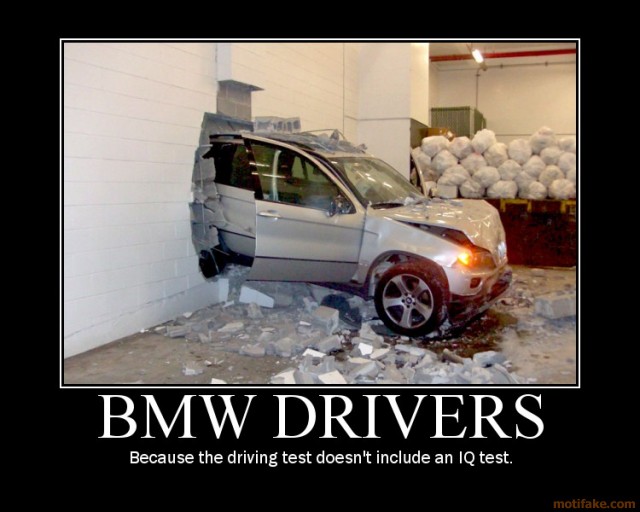
“I payed more for this car than you will make in a year, therefor get out of the way!”
Money can’t buy love, but having a lot of it (or at least blowing a lot of it on a fancy car), seems to buy you plenty of smug righteousness. I am not sure why the Lexus/BMW brand brings out the inner douche rocket in so many but that fine engineering must do something to the brain because I have noticed these drivers are always the first to honk, and the last to let off the horn.
Like most road users they have very little understanding of the law, but they do understand the cost of fixing a scratched quarter panel, if you get into a verbal debate with one of these dipshits simply remind them that the best way for them to avoid having to pay for expensive body work is for them to NOT hit you with their car.
Giant SUV/Huge Pickup Truck Drivers:
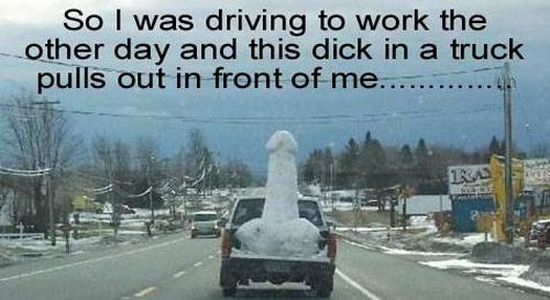
“HEY FAG GET OUT OF THE ROAD!”
80% male these dipshits are overcompensating for their lack of “gear inches.” As such they have surprisingly fragile egos, are quick to take offense and easily enraged. Your ease in navigating the narrow streets of Boston subconsciously reminds them that the car commercials all lied to them when they showed rugged dirt piles for them to run their giant machines over. The reality of non-stop bumper to bumper traffic leaves them with enough time, that even these strangers to self inspection, will finally realize that they are wasting a lot of gas money to sit in traffic every day, and parking is always a bitch.
Because of the lack of confidence in their own genetic lottery winnings these dipshits have been known to get out of their giant-mobiles and start a fist fight, best to avoid them by leaving them stuck in traffic while you wiggle your little finger at them.
Bus Drones:

“I do the same thing every day, I do the same thing every day, I do the same thing every day, I do the sam…OH SHIT A CYCLIST!”
Of all the dipshits on the list these people might be the most worthy of pity and also some of the most dangerous. Bus drivers have a lot to deal with, they are trying to move a giant vehicle full of (often angry) Bostonians around narrow streets full of other dipshits.
Half of the negative interactions I have had with bus drivers have been because they bus driver has reverted to robot mode. They are simply praying to whatever god they hold dear that they can finish this shift before they have to stab that kid two seats behind them for not shutting the fuck up about his girlfriend…and as such are not paying any attention.
The other half are because the bus driver have become so empty inside from the rigors of their job that they think everyone else is empty and seeking death as well. As such they are not only clumsy but malicious in their poor driving.
You can avoid bus drone dipshits in one of two ways, speed up and outrun them, or slow down and let them outrun you. Either way these mega sized dipshits are like the Wu Tang Clan. (nothing to fuck wit)
The Shoaler:
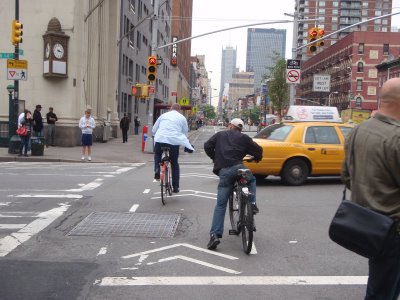
“……” (They are most often silent)
For those of you not “in the know” getting “shoaled” is when a slower cyclist passes you (often on the right, or in a dangerous way) proceeds to run the red light you are stopped at, and then continues to ride super slow forcing you to pass them once the light turns green. This can happen many, many….many times. Its especially bad if this dipshit thinks they are some sort of elite urban rider and that there is a video being made of them “bombing” through traffic. Then not only are they riding slowly, but dangerously all over the place.
These dipshits can be avoided like bus drones, either by speeding up or slowing down, but I prefer intervention. If you can ride up next to them and kindly explain that an “on your left” and a pass on the left is preferable to just passing silently within inches on your right. Also that if they are going to run red lights and continue to ride so slowly they might want to be nice and allow faster traffic to pass on the left. I don’t usually give any class of dipshit this much effort, but cyclists are small in numbers and the more we can convert into non-dipshit categories the better.
Uber-Insane Cab Driver:
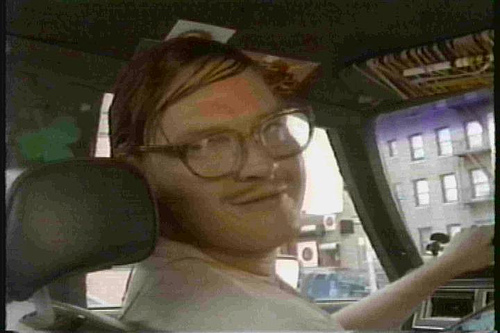
“You get out of road! You, out of road! Get out, road out, get get get, out out out!”
Their are crazy, violent, evil, cab driving dipships in Boston, but I am not talking about them, I am talking about the really bad ones. They are most often characterized by being morbidly unhealthy, to the point where they have started to merge with their cab seat in some sort of burger king lubricated human/cab hybrid. They often have a limited grasp on the English language (even if born and raised in this country), and use the horn the way Jackson Pollack used paint, they drive all day so they have the skills to make a cab do all sorts of magical dodgy type things, they just choose not to because they would rather see you splayed over the hood.
There is no reasoning with these people, and because their cars are only aesthetically enhanced by having a little cyclist blood on them you can’t appeal to the impulse to keep the paint looking nice. Your only hope is to look for the signs of a dipshit cab rage outbreak.
If you see someone on the side of the road with their arm in the air, immediately start scanning for a cab missile that will be approaching. Assume any cab not moving over 15 mph is about to poop some passengers out (even if in the middle lane at a red, in fact especially in the middle lane at a red light). Assume any cab parked on the side of the street is about to do a u-turn. And never, ever miss a chance to lightly spank the cab drivers (right on their shapely buttocks) in Harvard Square who bend over and chat with other cab drivers in the bike lane. They like it, or at least I assume they like it or else why would they hang their giant asses out into the bike lane like that all day long?
Aggressive Street Crosser:
“Hey look lots of moving cars, trucks, buses, trains, and bicycles, now would be a great time to run out into the street!”
I have written extensively about pedestrians, even going so far as to write a guide for how to deal with them. But this particular kind of dipshit is unique to the streets of Boston. An aggressive street crosser is unique in their lack of any sense of self preservation. They will run (not walk) into any amount of traffic, because…fuck it…why not!
These people are moving bike crashes waiting to happen, my suggestion is get some of your friends to throw things at you in a parking lot so you can practice your dodging skills. Barring that try to hit with the shoulder and not the front wheel, it will make the impact easier on you.
Obviously this is not an exhaustive list, so if you know of any other types of dipshit that you encounter on a regular basis feel free to leave them in the comments.
Add to Reddit. Posted in bostonbiker, Uncategorized | 5 Comments »
The Word On The Street
 Here is what people are saying
- Where bicycles are prohibited in Massachusetts August 16, 2023TweetThe main issue you will confront if you get into a dispute with police over bicycle prohibitions is whether the prohibition is supported by law. Often it is not. Example: the ramp from Commonwealth Avenue to Route 128 northbound and … Continue reading →jsallen
- Where bicycles are prohibited in Massachusetts August 16, 2023TweetThe main issue you will confront if you get into a dispute with police over bicycle prohibitions is whether the prohibition is supported by law. Often it is not. Example: the ramp from Commonwealth Avenue to Route 128 northbound and … Continue reading →jsallen
- It’s Finally Happening! 5th Annual Hot Cocoa Ride Feb 12! February 8, 2022... Continue reading →commonwheels
- It’s Finally Happening! 5th Annual Hot Cocoa Ride Feb 12! February 8, 2022... Continue reading →commonwheels
- Hello world! June 9, 2021Welcome to WordPress. This is your first post. Edit or delete it, then start writing! Continue reading →thecommunityspoke
- Run The Jewels Lead Free Pewter Hand Carved And Cast Pin Set January 3, 2021Made these lovely RTJ fist and gun pin set. Hand carved in wax, and then cast in lead free pewter. Because these are made by hand you can do fun things like add an extra small pin so that they sit just so (also means they have “customized” brass back plates to accommodate the extra […]Boston Biker
- My Work In The Wild: Feather Head Badge With Chris King Headset January 3, 2021One of my customers sent me this amazing picture of my feather badge installed on their (awesome!) bike. Check out Manofmultnomah (here and here), apparently Chris King took some interest in it as well. Want one of your own? Buy it here, or here... Continue reading →Boston Biker
- Boston’s Invitation to Improve Biking in Boston: Draw on Some Maps! December 14, 2020TweetSometimes, the best way to gather ideas and feedback is to let people draw on some maps. Last night, at the Bike Network Open House, pedallovers unveiled a draft for their upcoming plans for a more connected biking network infrastructure … Continue reading →greg
- Boston’s Invitation to Improve Biking in Boston: Draw on Some Maps! December 14, 2020TweetSometimes, the best way to gather ideas and feedback is to let people draw on some maps. Last night, at the Bike Network Open House, pedallovers unveiled a draft for their upcoming plans for a more connected biking network infrastructure … Continue reading →greg
- Boston’s Invitation to Improve Biking in Boston: Draw on Some Maps! December 14, 2020TweetSometimes, the best way to gather ideas and feedback is to let people draw on some maps. Last night, at the Bike Network Open House, pedallovers unveiled a draft for their upcoming plans for a more connected biking network infrastructure … Continue reading →greg