The Latest From BostonBiker.org
News, Events, Updates
Action Alert: Two Opportunities This Week To Stand Up For Cyclists On DCR Roadways
Written by Boston Biker on Jul 16Tell DCR: Protect cyclists on your roadways
Last Thursday, we sent a powerful message to the Department of Conservation and Recreation (DCR) that we need more protected spaces for cyclists on our roads — and we need them now. Around 125 people stood ground on Fenway and Brookline Ave. to highlight the dangers of DCR’s unprotected bike lanes on those roads, proving in the process that even during rush hour cars can move just fine along Brookline Ave. with one less lane for vehicle traffic. Thank you to all of you who took time out of your day to be there! (If you missed it, here are some photo highlights.)
We urge you to now help us carry on our momentum from that demonstration with two actions this week aimed at convincing DCR to modernize its approach to bike safety and street design.
Images from last Thursday’s people-protected bike lane action (Images courtesy of Donrick Pond)
On Wednesday, a coalition of advocacy organizations called the Memorial Drive Alliance will rally to call attention to the need for a road diet along Memorial Drive as part of the redesign process currently underway there. Following the rally, there will be a critical mass-style ride along Memorial Drive, from JFK St east to the BU rotary, to show how the road could be transformed with one less lane for cars in each direction.
Despite overwhelming public comment in support of improving the corridor for walking and bicycling and expanding green space, at the last public meeting DCR presented a plan which retains four lanes of motor vehicle traffic for most of Memorial Drive, including the parts where these improvements are most needed.
Wednesday’s ride will be a highly visible way to try to change these plans before they are finalized.
Rally and Ride
Wednesday, July 17 starting at 5:30pm
Intersection of Memorial Drive and JFK Street
RSVP
As last week’s demonstration showed, if we speak up publicly we’ll be heard. Thursday’s action received significant favorable coverage in the press, got more elected officials at the state level engaging in the conversation, and renewed attention from the City of Boston to continue expediting new protected infrastructure on Boylston St and, together with DCR, at intersections with Park Drive.
In addition to attending the rally Wednesday, it is critically important to write to DCR – even if you previously wrote in – to ask them to change their plan. To submit comments, visit their website and choose “Memorial Drive Greenway Improvements Phase III”. Key points to include:
Replace 2 vehicle travel lanes with a protected bi-directional bike path. (Retain existing paths and sidewalks for pedestrians).
Protect existing trees and plant new trees wherever there are gaps.
The second activist opportunity this week is DCR’s Stewardship Council on Thursday morning, where you can share feedback directly to the Commissioner and members of the Council about Memorial Drive and Park Drive/Fenway, as well as the agency’s general unwillingness to implement physically separated bike lanes.
DCR Stewardship Council Meeting
Thursday, July 18 from 8:30 – 11am
Dillaway-Thomas House, 183 Roxbury Street
Roxbury, MA 02119
The public comment period is toward the beginning/middle (full agenda) of this meeting, and then the public can join a working group to continue to talk with council members. If you plan to speak and have something written, please bring 10 copies. Talking points you could include:
DCR roadways where you travel, and safety concerns that you have experienced on them (including crashes)
Positive experiences you have had traveling in protected bike lanes, and an ask to start using protected bike lanes on DCR roadways
In general, why it is important to you for DCR to prioritize walking/biking/green space on and along their roadways
Particular comments related to Fenway/Park Drive and their intersections, the Arborway in Jamaica Plain, or Memorial Drive
These meetings rarely happen in Boston, so this is a unique opportunity to address DCR directly. We hope you can join us!
 Add to Reddit.
 Posted in advocacy | Comments Off on Action Alert: Two Opportunities This Week To Stand Up For Cyclists On DCR Roadways
Action Alert: People-Protected Bike Lane on Fenway THIS THURSDAY
Written by Boston Biker on Jul 09From the email:
Tell DCR: Protected Bike Lanes Save Lives
New bike lanes coming soon to the Fenway area will leave cyclists vulnerable unless the Department of Conservation and Recreation (DCR) tweaks plans to include some form of physical separation. With lane striping set to begin any day now, we ask you to join us this Thursday for an urgent demonstration calling on DCR to protect these bike lanes and improve conditions throughout this busy corridor for people who bike.
People-Protected Bike Lane on Fenway
People-Protected Bike Lane on Fenway
Thursday, July 11
Intersection of Fenway and Brookline Ave. (see map here)
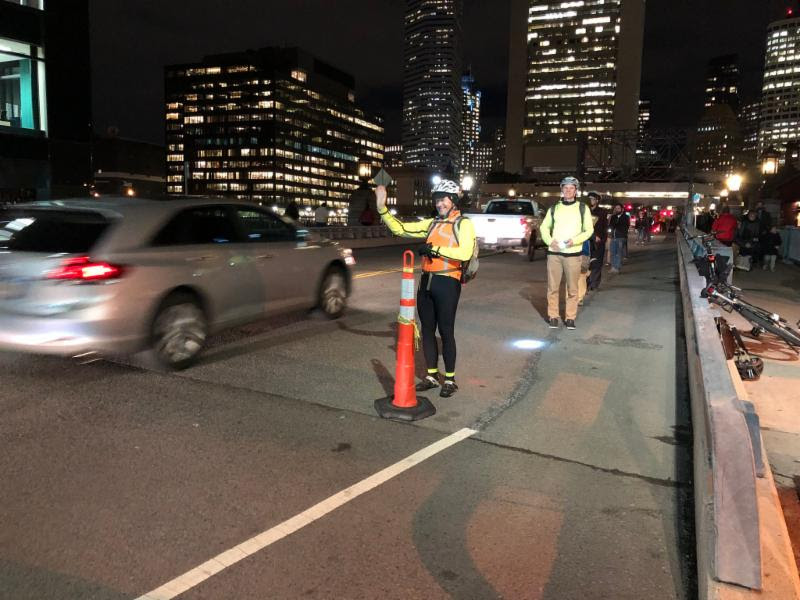
An image from the first people-protected bike lane demonstration in Boston,
on Congress St in December 2017.
Protected bike lanes (PBLs) are nearly twice as effective as painted bike lanes, and are the accepted safety standard for roads like Fenway and Park Drive; the MassDOT Municipal Resource Guide for Bikeability recommends PBLs on any road with more than one lane of traffic in each direction. However, DCR has decided to leave new bike lanes on Park Drive and Fenway unprotected, and has neglected to improve the intersections between those roads and Brookline Ave.
The Park Drive bike lane will be between on-street parking and two lanes of fast-moving traffic. Putting cyclists in the door zone on busy Park Drive is putting them in danger. And while the unprotected bike lane on Fenway isn’t designed in a door zone too, DCR’s refusal to add a physical barrier to that paint-buffered bike lane — DCR claims that it gives bicyclists a “false sense of security” — is completely backwards. During Boston’s budget hearings this spring, a cyclist shared her story of being hit from behind on Park Drive — a problem that could still happen with DCR’s unsafe designs. February’s crash that killed Paula Sharaga as she biked through the intersection of Brookline Ave. and Park Drive made the need for protection painfully clear.
DCR’s design decisions are made more frustrating by the fact that the Boston Transportation Department has already begun building PBLs on Brookline Ave., and has committed to significantly expediting the timeline to add protected bike lanes to an abutting section of Boylston St.
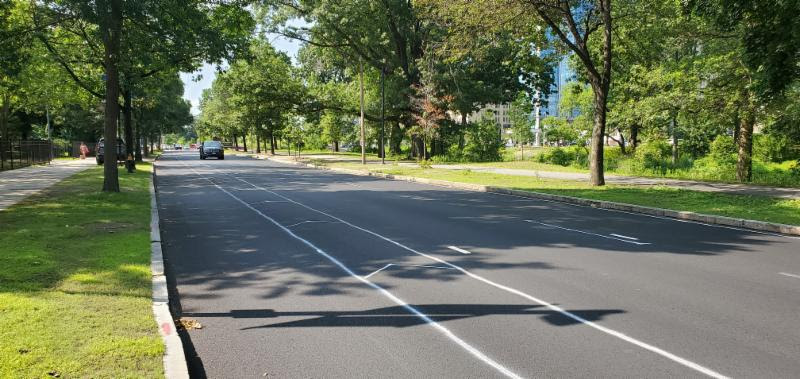
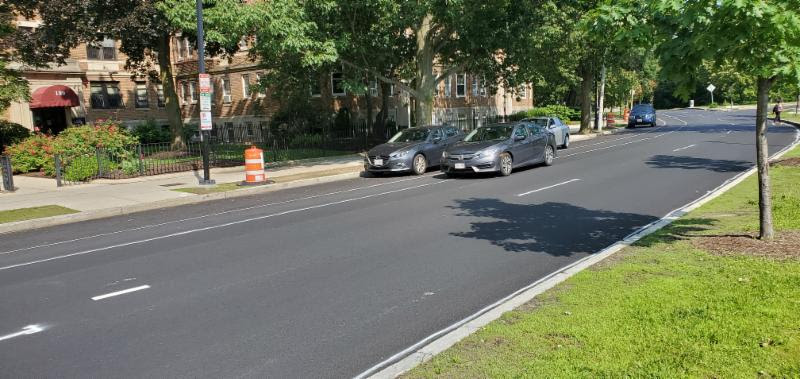
Preliminary striping shows a paint-buffered bike lane on Fenway (top)
and a door-zone bike lane on Park Drive (bottom).
We need your help to convince DCR to change course now, before the unprotected infrastructure is implemented!
- Join the people-protected bike lane — This Thursday, stand in support of protected bike lanes on Park Dr. and Fenway. In addition to these roads, we are also calling on DCR to make PBLs the norm for similar areas; recent DCR projects, and plans for future ones, also include unprotected bike lanes.
- Make your voice heard — Contact DCR to oppose their dangerous design, and urge lawmakers to step in. Even if your state representatives don’t cover this area, they can still influence broader DCR policy now and in the future. Share feedback to DCR Commissioner Roy and Governor Baker. For lawmakers, email Representative Chynah Tyler and Senator Will Brownsberger, who represent this area, and your own state senator and representative (find contact info here). For all emails, please CC [email protected].
- Save the date — DCR’s Stewardship Council meets next week on Thursday, 7/18, at which you can share feedback on the agency’s approach to PBLs and other bike infrastructure. If DCR ignores us now, this meeting will be our next opportunity to apply pressure about PBLs.
“If Paula were here, she would say, ‘Don’t mourn: Organize, and make sure this doesn’t happen to anyone else,” Todd, a long-time friend of Paula Sharaga’s, said at her ghost bike ceremony. That time to organize and push for change is here.
We hope you’ll join us in telling DCR that protected bike lanes save lives.
Support the Bike Union!
The Bike Union relies on membership and donations to support our work. The more dues-paying members we have, the more we can do on behalf of you and everyone who bikes in Metro Boston.
JOIN, RENEW, OR DONATE TODAY!
Add to Reddit. Posted in advocacy, Commuting, infrastructure | Comments Off on Action Alert: People-Protected Bike Lane on Fenway THIS THURSDAY
Temporary Closure Of The Paul Dudley White Bike Path
Written by Boston Biker on Dec 21Got this in the email, if this is part of your commute you might need to change some things up:
DCR Recreational Advisory: Temporary Closure of the Paul Dudley White Bike Path in Boston
WHAT: Beginning on Monday, December 21, 2015 and continuing to Friday, January 22, 2016, the Department of Conservation and Recreation (DCR) will be implementing a temporary closure of Paul Dudley White Bike Path along the Boston side of the Charles River between the Boston University Bridge and the River Street Bridge, to accommodate repairs to the pedestrian bridge.
WHERE: Paul Dudley White Bike Path, Boston, between the Boston University Bridge and the River Street Bridge
WHEN: Monday, December 21, 2015 and continuing to Friday, January 22, 2016
Add to Reddit. Posted in Commuting, infrastructure, news | 5 Comments »
Public Meetings About Walking And Biking Paths
Written by Boston Biker on Sep 30Join in these DCR sponsored meetings and let your voice be heard to support more walking and biking paths.
———–
From Livable Streets:
Please join us for a series of public meetings where the Massachusetts Department of Conservation and Recreation (DCR) and the Emerald Necklace Conservancy will present and obtain feedback on options for improving safety and accessibility for all people walking, running, biking, and driving, at three key areas:
Perkins St and Parkman Dr – Perkins St Pedestrian Crossing Study
Thursday, October 1, 6:30 – 8:30pm
@ Arnold Arboretum Visitor Center, Hunnewell Bldg
125 Arborway, Boston
Centre St from the VFW Parkway to Murray Circle – Centre St Corridor Study
Wednesday, October 7, 6:30 – 8:30pm
@ Arnold Arboretum Visitor Center, Hunnewell Bldg
125 Arborway, Boston
The Arborway between Eliot St and South St, including Kelley and Murray Circles – Arborway Multi-modal Improvement Project
Wednesday, October 14, 6:30 – 8:30pm
@ Arnold Arboretum Visitor Center, Hunnewell Bldg
125 Arborway, Boston
This project is an important piece of the Emerald Network, a vision for 200 miles of seamless greenways across the urban core to create a 21st-century recreation and transportation system that is safe and convenient for all. To learn more about our initiativeclick here.
Add to Reddit. Posted in advocacy, Commuting, infrastructure | Comments Off on Public Meetings About Walking And Biking Paths
Are You Part Of The .05%?
Written by Boston Biker on Feb 19From the BCU:
Bostonians making polite requests for a clear path on one of the city’s key bike routes were met with disdain from the state agency responsible for maintaining the paths.

With a rapid-response social media campaign, Boston residents put a face on the purported “.05%” of cyclists who bike through the winter. Photo: Boston Cyclists Union
Here’s how one unnamed official from the Massachusetts’ Department of Conservation and Recreation responded in an internal email thread to a message from a Boston resident asking for better snow removal on the Southwest Corridor, an important off-street bike path. The leaked email was published on the Boston site Universal Hub (emphasis ours):
Frankly, I am tired of our dedicated team wasting valuable time addressing the less than .05% of all cyclists who choose to bike after a snow/ice event… We should not spend time debating cyclists with poor judgement [sic] and unrealistic expectations, and stick with [the staffer]‘s recommendation that they find other transportation. If someone is completely depending on a bike for year-round transportation, they are living in the wrong city.
Oh man, someone either doesn’t know how to do math, or hasn’t been outside lately. I see literally dozens of cyclists riding EVERY DAY, through all sorts of weather. If I am seeing that many while riding around that means there are likely hundreds of people cycling to work every day even on the most shitty of winter days, and on cold but dry days many hundreds.
Even more would do so if the DCR cleared snow out of bike lanes/paths. It’s not so much that I get pissed when the paths are not plowed to perfection (although I was on the SWC today and it was in a horrible state), but the attitude of this person is just atrocious, do they really think so little of cyclists? Would they say the same thing to people driving cars if the roads were not cleaned well enough? Perhaps people driving a car in Boston are living in a city that just can’t accommodate clearing the roads…maybe this person needs to find a new line of work?
I have started to think that people are not skilled enough to drive cars in the snow and that doing so puts them and others at risk for injury. I would think the DCR would welcome more cyclists, as it means less cars, and less road damage, and less work for them….not to mention all the lives that would be saved by getting people with only a basic set of car driving skills off the road in the winter.
hit up the BCU website if you want to help fight this kind of silly behavior.
Update:
Read more here from BCU and here from MassBike
Add to Reddit. Posted in advocacy, Commuting | 3 Comments »
The Word On The Street
 Here is what people are saying
- Where bicycles are prohibited in Massachusetts August 16, 2023TweetThe main issue you will confront if you get into a dispute with police over bicycle prohibitions is whether the prohibition is supported by law. Often it is not. Example: the ramp from Commonwealth Avenue to Route 128 northbound and … Continue reading →jsallen
- Where bicycles are prohibited in Massachusetts August 16, 2023TweetThe main issue you will confront if you get into a dispute with police over bicycle prohibitions is whether the prohibition is supported by law. Often it is not. Example: the ramp from Commonwealth Avenue to Route 128 northbound and … Continue reading →jsallen
- It’s Finally Happening! 5th Annual Hot Cocoa Ride Feb 12! February 8, 2022... Continue reading →commonwheels
- It’s Finally Happening! 5th Annual Hot Cocoa Ride Feb 12! February 8, 2022... Continue reading →commonwheels
- Hello world! June 9, 2021Welcome to WordPress. This is your first post. Edit or delete it, then start writing! Continue reading →thecommunityspoke
- Run The Jewels Lead Free Pewter Hand Carved And Cast Pin Set January 3, 2021Made these lovely RTJ fist and gun pin set. Hand carved in wax, and then cast in lead free pewter. Because these are made by hand you can do fun things like add an extra small pin so that they sit just so (also means they have “customized” brass back plates to accommodate the extra […]Boston Biker
- My Work In The Wild: Feather Head Badge With Chris King Headset January 3, 2021One of my customers sent me this amazing picture of my feather badge installed on their (awesome!) bike. Check out Manofmultnomah (here and here), apparently Chris King took some interest in it as well. Want one of your own? Buy it here, or here... Continue reading →Boston Biker
- Boston’s Invitation to Improve Biking in Boston: Draw on Some Maps! December 14, 2020TweetSometimes, the best way to gather ideas and feedback is to let people draw on some maps. Last night, at the Bike Network Open House, pedallovers unveiled a draft for their upcoming plans for a more connected biking network infrastructure … Continue reading →greg
- Boston’s Invitation to Improve Biking in Boston: Draw on Some Maps! December 14, 2020TweetSometimes, the best way to gather ideas and feedback is to let people draw on some maps. Last night, at the Bike Network Open House, pedallovers unveiled a draft for their upcoming plans for a more connected biking network infrastructure … Continue reading →greg
- Boston’s Invitation to Improve Biking in Boston: Draw on Some Maps! December 14, 2020TweetSometimes, the best way to gather ideas and feedback is to let people draw on some maps. Last night, at the Bike Network Open House, pedallovers unveiled a draft for their upcoming plans for a more connected biking network infrastructure … Continue reading →greg